


Paver Patio Installation in Fort Mill, SC: The Eight Inches Nobody Sees
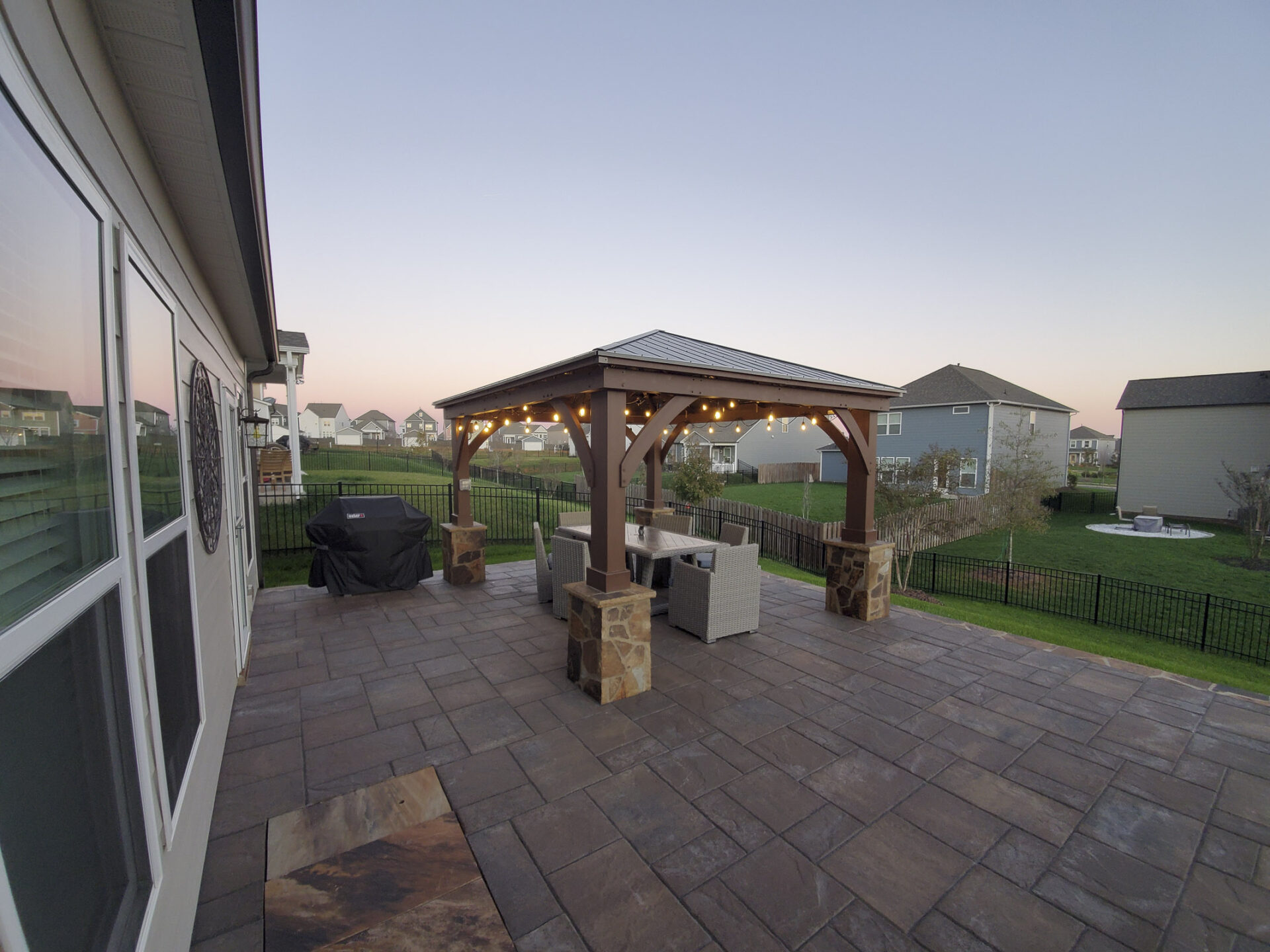
A paver patio installation in Fort Mill, SC is judged on the top inch and decided by everything below it. The pavers are what homeowners compare between quotes, and they are close to the least important variable in how flat the surface is ten years on.
In the Carolina Piedmont the thing acting on a patio is the red clay beneath it. Clay holds water, swells when saturated and shrinks as it dries, repeatedly, within a single year here.
The Stone Man has built custom patios and hardscapes across Fort Mill, Charlotte and the surrounding communities since 2001. Every patio we install is built to guard against settlement and to drain properly, and that work happens in the excavation rather than in the paving.
Related: Is a Flagstone Patio the Missing Piece in Your Backyard?
What Sits Under A Paver Patio, And How Deep Does It Go?
Four layers, and each has a job. At the bottom is the subgrade, which is whatever the site gives you once the topsoil is stripped, and in this region that is usually clay. Above it goes a compacted aggregate base, which carries and spreads the load, then a thin bedding layer that sets the pavers level, then the pavers as the wearing surface.
When a patio dips or ponds after a storm, the fault is rarely the paver. It is the base, or the clay under it. Our custom patio work is priced around those layers rather than around the surface pattern.
The excavation goes deep enough to get a real base in, which on clay means more than a patio built on sand or gravel soils would need. A pedestrian patio commonly wants six inches of compacted aggregate, and a surface carrying vehicles wants more.
With the bedding layer and paver thickness, the excavation runs eight to ten inches below finished level. This is the line item that varies most between two quotes for the same patio, and it is the one worth asking about by number rather than by adjective.
Why Does The Base Get Compacted In Layers, And What Holds The Edge?
Because a plate compactor only densifies the few inches directly beneath it. Dump eight inches of aggregate and run a compactor over the top and you get a firm crust with loose material underneath, which behaves exactly like no base at all once weight and water get into it.
Built properly, the aggregate goes in in lifts of a few inches, each compacted before the next is placed. It is slow, invisible in the finished work, and the largest single difference between two crews.
The outside edge is held by an edge restraint, spiked into the compacted base around the whole perimeter. A paver field is a set of unbonded units relying on friction, so the outer course takes the pressure every time somebody steps on it.
Without restraint that course creeps outward, the joints open, the sand washes out and the unlocking works inward. A seat wall or stone border does structural work as well as visual work, which is why an edge that has moved is a warning about the whole field rather than a cosmetic problem at the rim.
Related: Too Hot to Sit Outside? A Covered Patio in Fort Mill, SC, is Your Answer
What Goes In The Joints Between The Pavers?
Not merely filler. The joint material is what transfers load between units, so a field with washed-out joints stops behaving as one surface and starts behaving as several thousand loose ones.
Plain sand works and washes out. A stabilizing sand holds up far better under rainfall and a pressure washer, and limits what grows in the joints. Joints are the part of a patio needing attention over the years, and that is better understood before installation than after.
Ask Every Bidder For The Base Specification
If you have two quotes in front of you, ask each for the excavation depth, the base thickness, the lift height it is compacted in, the edge restraint and the joint material. Those five numbers tell you more than the paver selection does.
We’ll walk the property, look at what the clay is doing, and put those figures in writing. The Stone Man designs and builds patios and hardscapes across Fort Mill, Charlotte and the surrounding communities.
In Summary
Can a settled paver patio be lifted and relaid?
Often, and the pavers themselves are usually undamaged. Whether it holds depends on why it settled, since relaying over the same inadequate base repeats the problem within a few seasons.
How long does a paver patio take to build?
Longer than the paving itself suggests, because the excavation and the layered base compaction take up most of the schedule. On larger design and build projects the patio is one phase within a build measured in months rather than weeks.
Do concrete pavers and natural stone need the same base?
The base principles are the same, though the setting details differ, and flagstone in particular behaves differently set dry than on a mortar bed. Material selection happens during design, and the base is specified to suit what was chosen.
Related: What Good Landscape Design in Forth Mill, SC, Actually Changes